 Vietnamese
  English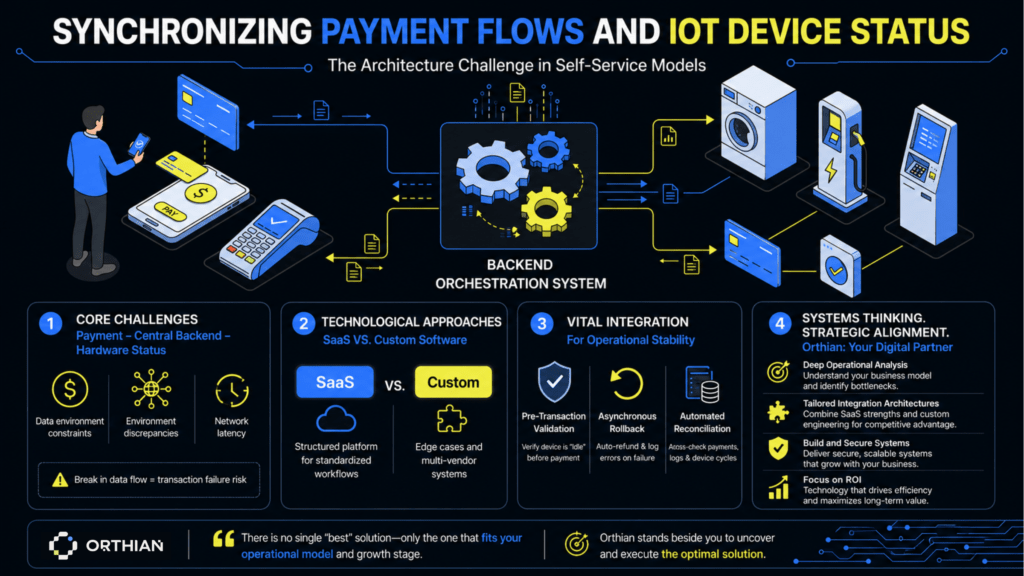
Self-service business models (or Unattended Retail) such as automated laundromats, EV charging stations, and smart kiosks have become a prominent trend for optimizing real estate and labor costs. However, from a technical standpoint, the maturity of this model does not reside in superficial elements like the user interface or hardware configurations. Instead, the core lies in the real-time synchronization between the payment flow, centralized backend logic, and the physical status of IoT devices.
In a system operating entirely without on-site staff, establishing and mastering this integration architecture is the deciding factor for operational stability and customer trust throughout their experience.
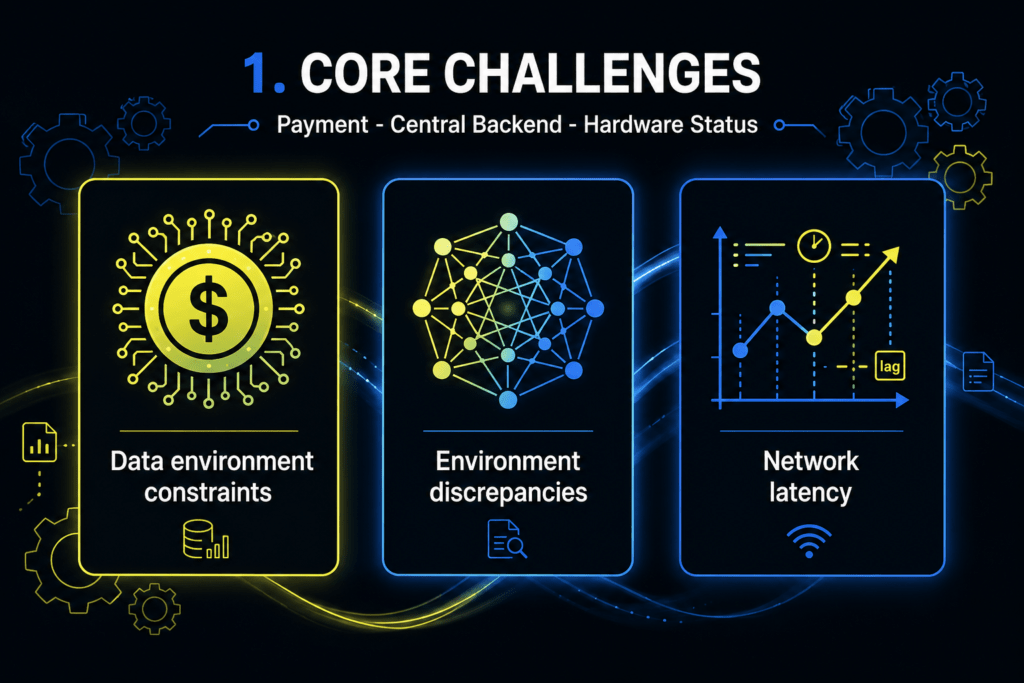
1. The Three Core Challenges: Payment – Centralized Orchestration – Hardware Status
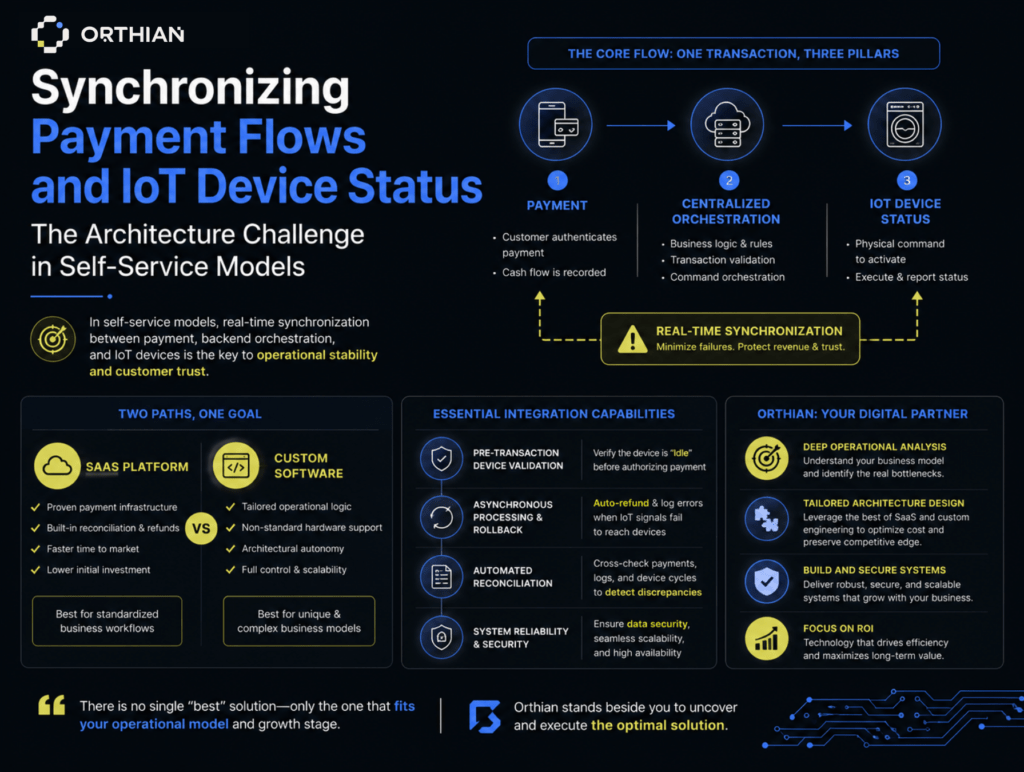
In a standard self-service transaction, the system must process a linear sequence of actions with absolute precision: the customer authenticates the payment -> the cash flow is recorded -> the hardware receives a physical command to activate.
The greatest challenge here is handling data environment discrepancies and network latency. If the data flow among these three pillars breaks down, the business faces transaction failure risks. For instance, a customer’s bank account or e-wallet is debited, yet the physical machine fails to start due to a lost IoT signal, network congestion, or an underlying hardware error undetected by the software.
Consequently, the core task is to design an exception-handling, system-logging, and cash-reconciliation architecture robust enough to protect both corporate revenue and the customer experience.
2. SaaS vs. Custom Software: Selection Based on Operational Standardization
To address the aforementioned challenge, businesses generally adopt one of two primary technological approaches. Each solution presents distinct advantages and technical constraints, requiring operators to analyze their actual business model rather than merely following industry trends.
When is an Off-the-Shelf Platform (SaaS) the Optimal Choice?
For industries with highly standardized operational workflows, utilizing established SaaS software or specialized industry platforms offers a high level of security.
- Advantages: These platforms possess payment infrastructures tested at scale, pre-integrated with complex reconciliation processes, financial reporting systems, and stable automated refund mechanisms. This enables businesses to optimize initial capital expenditure and mitigate the technical risks of rebuilding payment flows from scratch.
- Constraints: This solution only achieves maximum efficiency when the business conforms its operations to a pre-established workflow and utilizes hardware equipment included in the SaaS provider’s supported integration list.
—
When Should You Opt for Custom Software?
Custom software is not inherently a superior replacement in all cases, rather, it serves as the answer to edge cases or highly unique business models.
- Specialized Operational Workflows: When a business model is not yet standardized or widespread in the market, it requires complex operational logic or distinctive customer interaction scenarios that off-the-shelf solutions do not accommodate.
- Non-Standard Hardware Integration: When a business operates a multi-vendor equipment ecosystem utilizing distinct IoT protocols, it requires deep control over the source code layer to optimize hardware performance.
- Architectural Autonomy and Ownership: When a business demands absolute control over its data structures, feature roadmaps, and system scalability without depending on third-party update schedules.
3. The Vital Importance of System Integration
Whether a business elects to build upon an existing SaaS platform or develop a bespoke solution, the survival factor of the system remains the capability to design an integration architecture. To achieve high operational stability in a self-service system, system architects must comprehensively resolve fundamental technical challenges:
- Pre-Transaction Device Status Validation: The system must automatically query and verify that the equipment’s circuit board is in an “Idle” state before authorizing payment activation, minimizing hardware-induced transaction failures.
- Asynchronous Processing and Rollback Mechanisms: In the event of network latency where the IoT signal fails to reach the machine after a successful payment, the system must execute an automated rollback scenario, triggering an immediate refund and logging the error to safeguard user rights.
- Automated Reconciliation Systems: Constructing a continuous data reconciliation pipeline that cross-references payment gateway reports, backend logs, and the actual physical operation cycles of the hardware to instantly detect any discrepancies in cash flow.
4. Systems Thinking and Strategic Operational Alignment
At Orthian, we understand that a line of code holds no value if it fails to address business efficiency and optimize Return on Investment (ROI). Operating as a Digital Partner, Orthian’s core competencies lie in our capacity to:
- Deeply Analyze Operational Problems: Comprehending the unique identity, business model, and expansion vision of the enterprise to accurately pinpoint technological bottlenecks.
- Design Tailored Integration Architectures: Providing objective evaluations to advise businesses on which components to leverage from existing, stable market ecosystems and SaaS to optimize costs, and which core modules require custom engineering to preserve competitive advantages.
- Build and Secure Systems: Deploying precise engineering solutions that guarantee synchronicity, data security, and seamless scalability as the enterprise expands.
Phần kết luận
In technology, there is no single “best” solution, there is only the most appropriate solution for a company’s specific operational model and growth stage. Orthian’s objective is to stand alongside business leaders to uncover and execute that optimal solution.